Showing posts with label studio renovations. Show all posts

Monday, February 4, 2013

Quilt Studio Tour

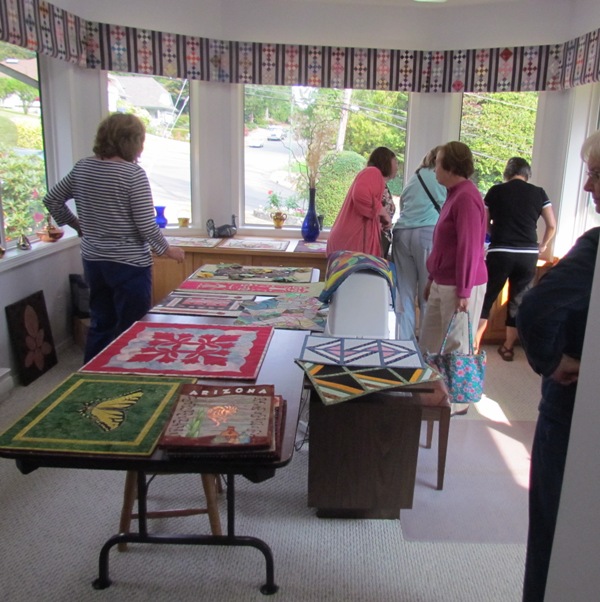
Last year I helped to organize a very popular guild event to raise funds for our workshop programme. Having spent a great deal of time during the previous 18 months designing and then renovating my own studio, I thought it would be a lot of fun to visit other quilters work spaces.

I thought that we are always curious about how other people use their creativity at work and given the huge popularity of home reno shows, it might be a fun time.

The committee chose 6 studios with a variety of spaces, some purpose built, some squeezed into spare rooms, basements and lofts. One quilter used three different rooms over two floors! We chose a long arm quilter, a mixed media artist, a business studio and more, it was fun taking the time to be part of poking around in our friends work places!


Daphne's studio showcases her journal quilts and small art pieces.


Lenny's studio is bright and full of windows looking out onto her beautiful garden.


Bette is showing us her custom built fabric storage drawers.

 
Sharon's studio takes full advantage of every square inch of space!

 
Laines' space downstairs is where she works on her painted and photographed pieces.

Thursday, July 5, 2012

Choosing Studio Flooring

We tend to think of the pretty or decorative items for our studios when planning a renovation but one of the most critical elements of a good studio design has to be what we place on the floor. When looking at flooring, think of these critical elements:

  • Safety-we don't want flooring that we can slip or trip on
  • Comfort-we can often be on our feet for lengthy periods cutting fabrics 
  • Cost -what kind of flooring will fit into our budget

When I was planning my studio I considered many options, some were impractical, some too expensive, but I'd like to tell you about the possibilities:


Concrete/cement

Probably the least desirable choice, concrete is hard on your legs and feet, but anti fatigue mats could be used. It can be cold, but that maybe appreciated in hot weather. Concrete is easy to clean and can be painted in a wide variety of colours and patterns. It also maybe the only option if you are working in a garage.


Linoleum

Lino is probably the cheapest option, it can often be installed by a non-professional, there are almost limitless design and pattern options. You might consider the peel and stick tiles.


Carpet or carpet tiles


I had carpeting in my basement studio for many years, it was warm but I had chosen a creamy beige Berber that showed dirt, threads and stains very easily. I usually steam cleaned the carpet once a year and vacuumed frequently but pins and beads were often lost "forever"!

If your studio does double duty as a guest room, then carpeting might be the only option, I would recommend a medium light or darker value and remember a loop pile will often grab hold of pins and not let them go, even with vigorous cleaning!

If carpeting is your best option then consider the peel and stick carpet tiles as a less expensive option.


Rubber


Rubber or composite flooring is often found in gyms or play areas for children, it is rather expensive. It is very easy on the feet and legs, although colors are limited. It will be marked or dented by heavy furniture.


Cork
Cork has many redeeming qualities, it is warmer than other laminate or wood floors, it's a renewable resource, and it has some cushioning properties. Cork flooring was my first choice for the floor in my studio. Unfortunately, the cost of 324 square feet with underlay was going to be over $2500.00, too high for my budget.


Hardwood


Perhaps your studio is in an older building and you are fortunate to have some sort of hardwood flooring. Lucky you!  If you have it in your budget, it might be an option, however if the flooring is varnished or treated it might be susceptible to scratches and marking. 


Laminate

Laminate flooring was the final choice for my studio,  we purchased it on sale and also bought the best quality underlay we could find. Once we had taken up the old carpet, we discovered that the cement floor was terribly uneven, too uneven to lay the laminate, darn! Fortunately I have a talented son in law who laid a plywood subfloor to level it out. I was surprised that there was a 2" difference from one corner of the room to the opposite side. 

My husband laid the floor and I love the look.


Other considerations:


DIY or professional installation? Consider the cost of hiring someone to install your flooring if you don't want or are unable to do it yourself. Most flooring installation is fairly straight forward, but if you run into problems like I did, then going to the professionals might be your best route.


Additional flooring: consider placing anti fatigue mats in areas where you are standing for periods of time such as in front of the cutting table.


Place mats under chairs to protect surfaces and prevent wear in front of sewing machines and computers.

You can save money by using or repurposing furniture in your studio, but don't skimp on flooring, buy the best that you can afford. It will pay off in years to come.


Wednesday, June 20, 2012

Studio Reno is Done! almost....

I'm thrilled with my new studio and have enjoyed working in it the last few days! I learned:
  • renos take twice as long as expected
  • little issues along the way cost the most!
  • the decorating will take time
  • many wonderful people made it all possible...thanks to Henry and Sean!
Here's some pictures of the studio finished but empty, ready for the 'stuff'':


The floor space measures about 250 square feet, there's just one window but lots of wall space. I choose Navajho White (Benjamin Moore) for the walls and the brick and accent wall was Terra Red, why be shy?

I'll write another blog post about the flooring choices.

The lighting is all natural tube and I have a couple of other lights in work areas. We've maxed out the electrical possibilities so I'll need to be careful about the demands.

Here are the finished pictures, just need to do a bit of decorating!


I love my little fireplace, the remote control is on top, just a click of a button and I can have roaring flames without heat! Or heat without flames, it'll be nice and cozy in the winter as its my only source of heat in the room. I'll be putting a rod at the top of the brick wall to hang quilts.


Desk area is under the window, there will be a large bulletin board on the wall behind the chair and the desk will be replaces by a proper L shaped work area with filing drawers underneath. I'll be buying mats today to protect the floors under the chairs.


My cutting table is my best purchase for the room. Its an Ikea kitchen island and was on sale for under $500. When we brought the boxes home I was very concerned that it would be too long at 72" but it fits very well and the storage is wonderful. My design wall is to the right and will measure 6ft wide x 5 ft tall. I lost a bit of height in the room because of the subfloor but I think it will work well.


This is another Ikea kitchen island, but I've modified it for my pressing table with a padded surface. It has wheels at one end so its semi-portable.


The bookcases are set up, there's till some boxes to unpack, so I'll be buying some more book cases, which I had planned on doing anyway. I used the height of the bookcases to take advantage of the bulkhead on the ceiling.

So all in all, I'm pleased with the results, there's still some tweaking to be done, another trip to Ikea, pictures and design wall to hang. But I can now work in the space after almost two months of frustration! I'll continue to post as changes are made, stop by and see me sometime!


Wednesday, May 16, 2012

Interview with Lois Hallock - Studio Designer Extraordinaire!

You may have been following the many trials and tribulation that I've been going through over the past few weeks as I endure a huge studio renovations. I'd like to say its all done and show you pictures.....but part of the sub floor is in and progress is being made, albeit rather slowly!


But I have spent a lot of time preparing for the reno, beginning almost a year ago when I first decided to move ahead. I had purchased Creating Your Perfect Quilting Space by Lois Hallock and spent a great deal of time going through all the chapters, gathering ideas, pouring through the internet and making many, many floor plans on gridded paper. I'll be continuing to walk you through the steps of my reno but I wanted you to meet Lois and hear what she has to say about how to create YOUR perfect quilting space:

Can you tell us a little bit about how you became interested in Studio Design, Planning and Organization?

I am one of those natural born organizers. I really enjoy figuring out the best way to arrange a room and the best way to organize stuff. It is like a big puzzle that has a best solution. I am an engineer and I have worked for over 20 years optimizing factory work by planning lean work flow, along with storing tools, plans, and supplies right where they are needed. These principles are universal and I found out that I saw things just a bit differently than other quilters as a result of these experiences. My book “Creating Your Perfect Quilting Space” was a combination of all my passions, organizing, quilting, and helping others.

What do you like best about your work?
I love helping people! It gives me great joy to hear from a quilter after she takes my class or attends my lecture, that I changed her life. Often the cathartic affect of improving her quilt studio, kicks off a highly productive and creative phase for the quilter. Sometimes these quilters go on to improve other rooms in their house. Others jump into a new activity, like teaching or hosting groups in their quilt study. One of my favorite stories was from Terry Martin, whose quilt studio is seen on the cover of my book. Terry shared with me that she felt isolated in her studio and that neither her teenage daughter nor her husband stayed very long when they dropped in. Well there were no comfortable chairs and the space was not welcoming to visitors. So we added a loveseat and TV, positioning Terry’s sewing table such that she could watch while she sewed. She said the first time she was watching old movies and sewing, her daughter stopped by and just sat down to watch with her. They chatted and laughed while enjoying an afternoon together. Terry said it was all worthwhile to spend quality time with her daughter.


How can I plan my studio before I start moving things around?
I highly recommend planning first before moving furniture. In my book I tell you to draw your studio to scale and cut out index card models of your furniture in order to try different layouts without moving furniture. Many quilters find my Quilt Studio Planner with scaled furniture models included and my half pica scale to be a great shortcut. I challenge quilters to create seven different viable layouts and take a photograph of each. Print the photos out and spend some time gazing at them and deciding which layout is the best (just like you would spend time deciding how to lay out your blocks on a quilt). Your husband or son will thank you for only have to move the real furniture once and being sure everything fits once it is moved!

What are quick things I can do right now to make my Studio work well?
1. Fold your fabric and store it on shelves where you can see it. I demonstrate fabric folding as a part of my lecture. Fabric is what inspires you to create quilts. You need to get that same feeling that you get when you walk into a fabric store when you walk into your own quilt studio. Fabric fuels your passion and energy, clutter saps it.

2. Sign up for my monthly newsletter at my website: http://www.clearview-designs.com/


What are the most common mistakes quilters make when planning their studios?
1. “Circle the wagons” – I heard this term when watching a HGTV show on home décor. It is used to describe positioning furniture against the outer walls of the room, leaving the floor at the center empty. It is as if the room was spun in a big centrifuge and the furniture was pushed to the outside. This is very inefficient use of space. The use of peninsulas and islands produce much better flow and efficiency.

2. Too much horizontal surface. Quilters think that the reason their horizontal surfaces are piled under is because they don’t have enough surfaces. Well the opposite is true. The more horizontal surfaces you have, the more you tend to pile things on them. Instead go vertical with storage. You will have a lot less clutter and be able to find things when you need them.

3. Furniture without storage. Quilters use ironing boards that take up floor space and provide no storage. Instead use a buffet or dresser with lots of drawers to hold your pressing surface.


4. Using poor ergonomics by having wrong height surfaces and office chairs not designed for sewing posture. In my book I tell you how to measure for good ergonomic heights. Be aware that office chairs do not come far enough forward to meet your back when you are in “sewing position”. I offer the Heavenly Sewing Chair at my website which is a fantastic chair for quilters. It is built custom for you with your choice of fabric. I had the pleasure of helping a consulting client who is also a medical doctor. She was blown away by the improvements she experienced when her ergonomic issues were resolved. She was amazed that with all her medical knowledge, it was simply choosing the right furniture that improved her quality of her sewing experience.

I hope you have enjoyed some of the ideas that Lois has presented to us, I know that I have followed many of her suggestions and found them to be so useful. I'll be addressing some of them over the next few blog posts and I hope you'll get some ideas as well.
 
PS. the photos above are not my studio!

Wednesday, May 9, 2012

Studio Renovations - Life Goes On!

I should have titled this post "Life Happens", last week I had to take a three day trip to Vancouver and the renovation slowed down, a lot. Now its ground to a complete halt.
The wall is completely down and has been insulated and dry walled, just waiting for the mudding and taping.....the guy said he'd be here on Monday, its now Wednesday. But "for sure" he'll be here on Friday, hhhmmmm?
The old carpeting came up and I went to Rona and picked out a mid range laminate for the floor. I really did want cork but it would have been well over $2500, too much for my budget.
But "life happens" again and we discovered that the concrete floor was too uneven to install the laminate overtop. So..... Sean, my son-in-law, who is doing an awesome jobe, is getting ready to install an entire plywood floor over the the concrete. But that has to wait for the mudding and taping...... did I mention that I wanted this all done in 16 days? NOT GOING TO HAPPEN!
Today, my beloved husband is doing the final sanding of the ceiling, after he removed the "popcorn" stuff from the 70's, yech! Don't ever put that stuff up!!!
Now we're off to Benjamin Moore with out $5.00 coupons for paint colours....but no painting til next week, I guess!

The old panelling is down and ready for insulation and drywall.

My sewing room is now the dinning room table!

Wednesday, May 2, 2012

Studio Renovation Begins!

I've spent the last week packing up my studio, boxes and boxes of books, supplies, notions, threads and more. My entire studio is being renovated and I'm thrilled about the new possibilities! But......the "short term" pain is excruciating! There are boxes, pieces of furniture, icky carpet and scraps of wood to deal with.
I've actually spent about 6 months planning this renovation, measuring my square footage, making floor plans, drawing out possible layouts and purging out the stuff I no longer use. That was a freeing experience to let go of fabric, designs and more from a former business and planning the way forward for my dreams and plans. I'll be showing more of that a bit later on.
I've scheduled about 16 days for the reno, which my husband and son-in-law have said is unrealistic, but I do need to get back into the space as soon as I can! I'll be having separation anxiety!
The plan over the next couple of days is to pull down the panelling from one wall, its old mahogany that shows little holes where my husband used a pellet gun when he was young (and reckless!), he also found fire crackers that he tried to stuff into the holes! Next the old carpeting will be lifted and disposed of, no more carpet, hurray! Then there'll be insulation and drywall put up where the panelling was - only along one exterior cement wall - I think it'll be warmer in the winter.


The old wall is removed, we found old growth fir used as support for the panelling.

My sewing machine is in the midst of the rubble, I'm thinking optomistically that I might get some sewing done!

One bedroom with about 30 boxes of supplies piled into it!


Fabric storage is piled to the ceiling!

More updates as the work progresses!